


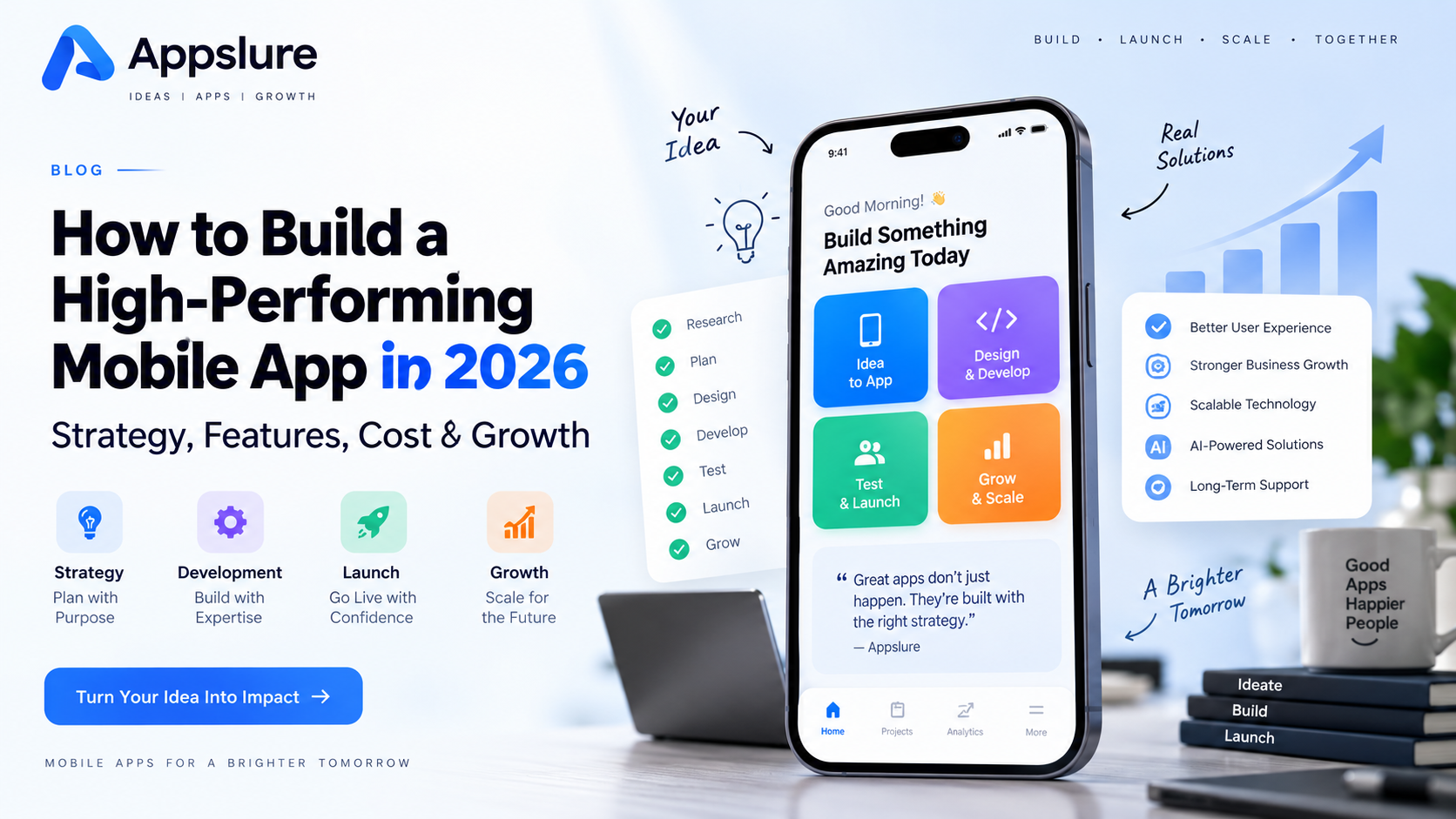
Mobile apps have become one of the most important digital touchpoints between businesses and their customers. From shopping and payments to healthcare, education, travel, logistics, and on-demand services, users expect brands to provide fast, convenient, and personalized mobile experiences.
However, creating a successful application is not only about attractive screens or writing code. A high-performing app requires the right product strategy, user experience, technology, security, testing, and long-term improvement plan.
For businesses planning a new digital product, working with an experienced mobile app development company can help transform an idea into a scalable application that supports real business goals.
In this guide, we explain the complete app development journey—from validating an idea and selecting the right technology to launching, maintaining, and scaling the final product.
Why Mobile Apps Still Matter for Businesses
A well-designed mobile application can create a direct connection between a business and its customers. Unlike a website that users may visit occasionally, an app can become part of a customer’s everyday routine.
Businesses use mobile apps to:
- Improve customer convenience
- Deliver personalized experiences
- Increase repeat engagement
- Simplify bookings, purchases, and payments
- Send relevant notifications and updates
- Create loyalty and rewards programs
- Improve internal business operations
- Collect useful product and behavioral insights
- Support new digital business models
The most successful apps are not built simply because a business wants an app. They solve a clear problem and give users a strong reason to return.
Start With a Clear Product Goal
Before UI design or development begins, the product objective should be clearly defined.
Start by answering a few important questions:
- Who will use the app?
- What problem does it solve?
- Why would users choose it instead of an existing alternative?
- What is the primary action users should complete?
- Which features are essential for the first release?
- How will the business measure success?
For example, an eCommerce brand may focus on repeat purchases, while a healthcare platform may prioritize appointment booking and patient communication. A logistics platform may focus on real-time tracking, driver management, and operational visibility.
Clear goals prevent unnecessary features from increasing development time, cost, and complexity.
Validate the Idea Before Building Everything
One of the biggest product mistakes is investing heavily before validating whether users actually need the solution.
Instead of launching a large application immediately, businesses can begin with a Minimum Viable Product, commonly known as an MVP.
An MVP includes the smallest set of features required to solve the core user problem.
A typical MVP process may include:
- Market and competitor research
- User persona definition
- User journey mapping
- Feature prioritization
- Wireframes and prototype
- MVP development
- Real-user testing
- Analytics and feedback
- Product improvement
This approach allows businesses to learn faster and make product decisions using actual user behavior rather than assumptions.
Choose the Right App Development Approach
The technology selected for an app affects performance, development speed, future scalability, and maintenance.
Native App Development
Native apps are developed specifically for a particular operating system, such as iOS or Android.
They can be a strong choice when the product requires:
- High performance
- Advanced animations
- Deep hardware integration
- Complex background processing
- Platform-specific functionality
Native development can provide excellent performance, but separate iOS and Android codebases may require additional development and maintenance resources.
Cross-Platform App Development
Cross-platform frameworks allow developers to create applications for multiple operating systems using a largely shared codebase.
This approach can be useful when businesses want:
- Faster development
- A consistent experience across platforms
- Easier maintenance
- Reduced duplicate development effort
- Quicker MVP delivery
The correct approach depends on the product, feature complexity, budget, performance requirements, and long-term roadmap.
Focus on User Experience, Not Just Visual Design
An attractive interface is important, but good user experience goes much deeper than colors, icons, and typography.
Every screen should help users complete an action with minimum friction.
Important UX considerations include:
- Simple onboarding
- Clear navigation
- Readable content
- Consistent buttons and interactions
- Fast search and filtering
- Easy-to-complete forms
- Helpful empty states
- Clear error messages
- Accessible design
- Responsive layouts
- Minimum unnecessary steps
Users should not need detailed instructions to understand basic actions.
A strong design process usually starts with user flows and wireframes before moving into high-fidelity UI design. This allows teams to identify usability problems before development begins.
Build a Scalable Backend Architecture
The mobile interface is only one part of the product. Many applications depend on backend systems that manage users, data, payments, files, notifications, analytics, and business logic.
Depending on the application, the backend may include:
- User authentication
- APIs
- Databases
- Cloud storage
- Admin panel
- Payment integration
- Push notifications
- Search functionality
- Role-based permissions
- Third-party services
- Analytics
- Logging and monitoring
Scalability should be considered early, particularly for products that expect rapid user growth, large media files, real-time communication, or high transaction volumes.
The goal is not to over-engineer the first version. The architecture should be practical for current requirements while remaining flexible enough to support future growth.
Add AI Where It Creates Real User Value
Artificial intelligence is becoming an important part of modern digital products, but simply adding an AI feature does not automatically make an application better.
AI should solve a real user or operational problem.
Useful AI applications may include:
- Intelligent search
- Personalized recommendations
- AI chat assistants
- Document summarization
- Voice transcription
- Image understanding
- Content generation
- Automated customer support
- Smart form completion
- Fraud or anomaly detection
- Predictive insights
- Workflow automation
Businesses should evaluate AI features based on usefulness, accuracy, privacy, operating cost, and overall user experience.
In many products, the best AI experience feels like a natural part of the workflow rather than a separate feature added only for marketing purposes.
Make Security Part of Development From the Beginning
Security should not be treated as a final checklist before launch.
Applications may handle personal information, login credentials, business data, payments, private communications, or sensitive documents. Security controls should therefore be considered throughout the product architecture and development process.
Important areas include:
- Secure authentication
- Encryption for sensitive data
- HTTPS communication
- Secure API access
- Role-based permissions
- Input validation
- Secure token handling
- Protection against common application vulnerabilities
- Dependency updates
- Server monitoring
- Backup and recovery planning
The exact security requirements depend on the industry, type of information being processed, and regions where the application operates.
Test the App on Real Devices and Real Scenarios
An application that works perfectly on a developer’s device may behave differently across phones, screen sizes, operating-system versions, and network conditions.
Testing should therefore cover much more than basic functionality.
Functional Testing
Functional testing checks whether individual features and complete workflows behave according to defined requirements.
UI Testing
UI testing verifies layouts, spacing, typography, buttons, forms, navigation, and responsive behavior.
Performance Testing
Performance testing evaluates startup time, loading speed, API response behavior, memory usage, and other performance factors.
Compatibility Testing
The application should be tested across supported devices, operating-system versions, and screen sizes.
Network Testing
Teams should check how the app behaves on slow, unstable, or interrupted internet connections.
Security Testing
Security testing helps identify weaknesses in authentication, APIs, permissions, and sensitive-data handling.
User Acceptance Testing
User Acceptance Testing confirms that the complete product flow makes sense from the user’s or stakeholder’s perspective.
Continuous testing throughout development is usually more effective than discovering major problems immediately before launch.
Prepare Carefully for App Store Launch
Publishing an application involves much more than uploading the final build.
Teams should prepare:
- App name
- App icon
- App screenshots
- Store description
- Privacy policy
- Support information
- Permission explanations
- Version information
- Test accounts when required
- Release notes
The application should also be reviewed against the current requirements of the relevant app stores before submission.
Businesses should have analytics in place at launch so that the team can understand what users do after installing and opening the application.
Track the Metrics That Actually Matter
Downloads alone do not show whether an application is successful.
Businesses should track metrics connected to the original product objective.
These can include:
- Sign-up completion rate
- User activation
- Daily active users
- Monthly active users
- Feature adoption
- Conversion rate
- Purchase completion
- User retention
- Subscription conversion
- Churn
- Crash-free sessions
- Average response time
- Funnel drop-off
For example, if a large number of users begin registration but do not complete it, the problem may be onboarding friction rather than a lack of interest in the product.
Analytics gives teams the information required to identify these problems and prioritize improvements.
Plan for Maintenance After Launch
A mobile app is an ongoing digital product, not a one-time project.
After launch, development teams may need to manage:
- Bug fixes
- Operating-system updates
- Device compatibility
- Security patches
- Performance optimization
- Backend monitoring
- API changes
- Third-party service updates
- New features
- User feedback
- Analytics
- App store updates
A structured maintenance plan reduces the risk of an application becoming slow, outdated, insecure, or unreliable over time.
Continuous improvement is particularly important because user expectations and platform requirements continue to evolve.
What Determines the Cost of Building an App?
There is no single fixed cost that applies to every application because each product has different technical and business requirements.
The overall investment is usually influenced by:
- Number of screens
- UI/UX complexity
- iOS, Android, or both
- Native or cross-platform approach
- Backend complexity
- Admin panel requirements
- Number of user roles
- Real-time functionality
- Payment integrations
- Maps and location services
- Video or audio functionality
- AI capabilities
- Third-party integrations
- Security requirements
- Testing scope
- Maintenance requirements
A simple informational or booking application will naturally require fewer resources than a marketplace, social network, fintech platform, or AI-powered SaaS product.
A detailed discovery phase is one of the most effective ways to create a realistic project estimate.
How to Choose the Right Development Partner
The cheapest development proposal is not always the lowest-cost decision over the complete life of a digital product.
A capable development team should understand both technology and product strategy.
When evaluating a mobile app development company in Delhi, businesses should look beyond portfolio screenshots and consider the team’s development process, communication, technical planning, testing standards, security practices, and post-launch support.
Useful questions to ask include:
- How will you define the MVP?
- Who will manage the project?
- How will milestones be reviewed?
- What technology do you recommend and why?
- How will the source code be managed?
- How will the application be tested?
- How will sensitive information be protected?
- What happens after launch?
- How are change requests managed?
- Can the architecture scale as usage grows?
Strong development partnerships provide visibility throughout the project instead of treating development as a black box.
How Appslure Approaches App Development
At Appslure, the development process starts with understanding the business objective and user problem before moving into design and engineering.
A structured project can include:
1. Discovery and Requirement Analysis
The first step is understanding the product idea, target audience, business objectives, technical requirements, and long-term vision.
2. Product Strategy and Feature Prioritization
Features are organized according to business importance and user value. This helps define what should be included in the initial release and what can be added later.
3. User Flows and Wireframes
User journeys are mapped before visual design begins. This ensures important workflows remain simple and intuitive.
4. UI/UX Design
Visual interfaces are created around the brand while maintaining usability, consistency, responsiveness, and accessibility.
5. Frontend and Backend Development
Developers build the application interface, backend systems, databases, APIs, and required business logic.
6. Third-Party Integrations
Depending on the product, integrations may include payments, maps, analytics, communication services, cloud storage, AI services, or other external platforms.
7. Quality Assurance
Features and complete workflows are tested across different scenarios before release.
8. Deployment Support
The application is prepared for production deployment and relevant app store submission processes.
9. Analytics and Monitoring
Analytics and monitoring can be configured to understand product usage, user journeys, technical performance, and important conversion events.
10. Post-Launch Improvement
Once real users begin using the application, feedback and analytics can be used to identify the next improvements.
The exact development process should be adapted to the product instead of forcing every business into the same predefined model.
Whether the goal is to launch an MVP, modernize an existing application, introduce AI functionality, or build a larger digital platform, the focus should remain on usability, reliability, scalability, and measurable business value.
Common Mistakes Businesses Should Avoid
Successful app development is also about avoiding decisions that create unnecessary risk.
Building Too Many Features Initially
More features do not automatically create a better product. Too many features can increase costs and make the user experience unnecessarily complicated.
Ignoring User Research
Building entirely on assumptions can result in features that users do not need.
Choosing Technology Only Based on Cost
The cheapest technical approach may create performance or scalability limitations later.
Ignoring Analytics
Without analytics, teams may know how many people downloaded the app but not understand where users struggle or why they leave.
Treating Launch as the End of Development
Real product learning often begins after launch. Businesses should be prepared to improve the product using real usage data.
Ignoring Performance
Slow loading times, unstable APIs, crashes, and poorly optimized screens can quickly damage the user experience.
What Makes an App Successful in the Long Term?
A successful application usually combines several factors:
Clear Purpose: Users immediately understand what the application helps them achieve.
Simple Experience: Important actions can be completed without unnecessary complexity.
Reliable Performance: The product remains fast and stable during normal usage.
Useful Features: Features exist because they solve actual problems.
Scalable Technology: The architecture can support future users, functionality, and integrations.
Continuous Improvement: Feedback and analytics influence future versions.
Strong Security: User and business information is handled responsibly.
Business Alignment: Product decisions support measurable company objectives.
Technology is important, but sustainable digital products succeed when technology, user experience, and business strategy work together.
Frequently Asked Questions
How long does it take to develop a mobile app?
The timeline depends on the number of features, design complexity, backend requirements, integrations, testing scope, and platforms being supported. A focused MVP can usually be completed faster than a large multi-role digital platform.
Should I build for Android or iOS first?
The decision should be based on your target audience, product strategy, budget, and technical requirements. Some businesses begin with one platform, while others choose a cross-platform approach to support both.
Do I need an MVP before building the complete product?
An MVP is useful when a business needs to validate demand, test important workflows, or enter the market quickly. It allows teams to collect real feedback before investing in a much larger feature set.
Can AI be added to an existing app?
Yes. Existing applications can integrate AI functionality through APIs, cloud-based AI services, or custom models depending on the use case and current technical architecture.
What happens after an app is launched?
The application should be monitored for crashes, performance, user behavior, retention, conversion, and feedback. Regular updates help maintain compatibility, security, performance, and overall product quality.
How do I know which features should be included in the first version?
Start with features directly connected to the main user problem. Features that are useful but not essential to completing the core journey can usually be planned for later versions.
Who owns the app source code?
Code ownership should be clearly defined in the development agreement before work begins. Businesses should also confirm access to repositories, cloud accounts, design files, databases, and relevant third-party platforms.
Final Thoughts
Building a successful mobile application requires much more than development alone. The strongest products begin with a clearly defined problem, prioritize the right features, deliver a simple user experience, and use technology that can support future growth.
Businesses should approach app development as an ongoing product journey: research, validate, design, build, test, launch, measure, learn, and improve.
A thoughtful strategy at the beginning can reduce unnecessary development, improve the customer experience, and create a stronger foundation for future expansion.
If you are planning a new mobile product, an MVP, an AI-enabled application, or a redesign of an existing app, Appslure can help turn your idea into a secure, scalable, and user-focused digital product with a structured approach from initial strategy through launch and ongoing improvement.

