


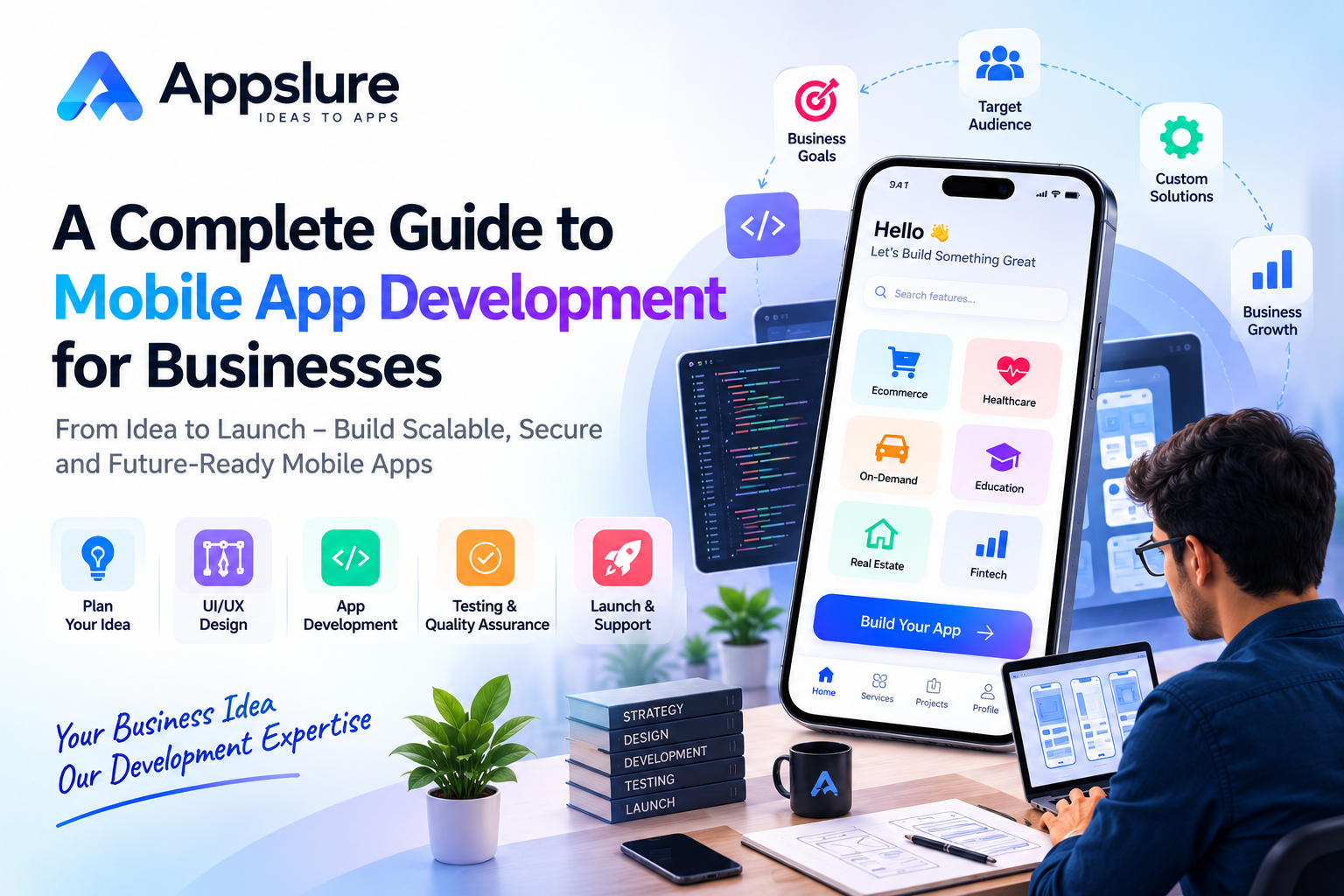
Introduction
Mobile applications have become an essential part of modern business strategy. From customer engagement and online sales to service delivery and internal operations, businesses across industries are using mobile apps to connect with customers and simplify everyday processes. A well-designed app can help businesses improve accessibility, strengthen customer relationships, streamline operations, and create new revenue opportunities.
However, building a successful mobile application requires more than simply developing screens and adding features. Businesses need to consider their target audience, business objectives, user experience, technology stack, security, scalability, performance, and long-term maintenance. Working with the right mobile app development company can help businesses turn an idea into a reliable, user-friendly, and scalable mobile product.
In this complete guide, we will explore the mobile app development process, different types of mobile applications, development platforms, essential features, estimated costs and timelines, technology considerations, current trends, and key factors businesses should consider before starting their app development journey.
What Is Mobile App Development?
Mobile app development is the process of designing, building, testing, deploying, and maintaining applications for mobile devices such as smartphones and tablets.
A mobile application can be created for a specific operating system, such as Android or iOS, or developed using technologies that allow the same codebase to support multiple platforms.
The development process generally involves several interconnected areas:
- Business and product planning
- Market and user research
- UI/UX design
- Frontend development
- Backend development
- Database development
- API integration
- Security implementation
- Testing and quality assurance
- App deployment
- Maintenance and updates
The objective is not simply to create an application that works. A successful business application should solve a specific problem, provide a smooth user experience, perform reliably, and support the organization’s long-term goals.
Why Mobile Apps Matter for Businesses
Mobile applications provide businesses with a direct digital channel through which they can interact with customers and deliver products or services.
Direct Customer Engagement
A mobile application provides businesses with a dedicated environment for communicating with customers. Features such as notifications, personalized content, loyalty programs, and in-app messaging can support ongoing engagement.
Unlike a traditional website, an application can also use mobile capabilities such as push notifications, camera access, GPS, biometric authentication, and device sensors.
Improved Customer Experience
A well-designed application can simplify complex processes.
For example, an ecommerce application can allow customers to search for products, compare options, place orders, make payments, and track deliveries from a single interface.
Similarly, a service-based business can allow customers to schedule appointments, communicate with staff, receive updates, and manage their accounts through an application.
New Revenue Opportunities
Mobile applications can support multiple revenue models, including:
- Product sales
- Subscription plans
- In-app purchases
- Commission-based transactions
- Premium features
- Advertising
- Service bookings
- Membership programs
The appropriate model depends on the business type, target audience, and overall product strategy.
Operational Efficiency
Mobile applications are not limited to customer-facing products. Businesses can also develop internal applications for employees, field teams, managers, delivery personnel, sales representatives, and other operational teams.
These applications can simplify workflows, improve communication, reduce manual processes, and provide real-time access to business information.
Types of Mobile Applications
Businesses can choose from several approaches depending on their requirements, budget, performance expectations, and target platforms.
Native Mobile Apps
Native applications are developed specifically for a particular operating system.
For example, iOS applications can be developed using Swift, while Android applications can be developed using Kotlin.
Native development provides strong access to platform-specific capabilities and can deliver highly optimized performance.
It is often suitable for applications that require advanced device functionality, high performance, complex animations, or deep integration with operating-system features.
Cross-Platform Apps
Cross-platform development allows businesses to create applications for multiple platforms using a shared codebase.
Technologies such as React Native and Flutter are commonly used for this approach.
The main advantages can include:
- Shared development effort
- Faster development cycles
- Easier maintenance
- Consistent functionality across platforms
- Reduced duplication of code
The appropriate technology depends on the application requirements and technical architecture.
Hybrid Applications
Hybrid applications combine web technologies with a native application wrapper.
This approach can be useful for certain business applications where development speed and broad platform compatibility are important considerations.
Progressive Web Applications
Progressive Web Apps, or PWAs, use modern web technologies to provide an application-like experience through a browser.
They can be useful when businesses want to provide mobile-friendly functionality without requiring users to install a traditional application from an app store.
Choosing Between iOS and Android
One of the first technology decisions businesses need to make is which mobile platforms to support.
iOS Development
iOS applications are designed for Apple’s ecosystem and can provide a consistent hardware and software environment.
Businesses targeting iPhone and iPad users may choose native iOS development when platform-specific performance and functionality are important.
Swift is one of the primary technologies used for modern iOS application development.
Android Development
Android supports a broad range of devices from different manufacturers and is widely used across international markets.
Businesses targeting Android users can develop applications using technologies such as Kotlin and Android’s modern development frameworks.
Supporting Both Platforms
Many businesses eventually require both iOS and Android applications.
The decision to launch on one platform first or release both simultaneously should depend on factors such as target customers, market demand, budget, product complexity, and business objectives.
The Mobile App Development Process
A structured development process helps reduce technical risks and keeps the project aligned with business goals.
1. Idea and Requirement Analysis
The first stage is understanding the business problem and defining what the application needs to accomplish.
Key questions include:
- Who will use the application?
- What problem does it solve?
- What are the primary user journeys?
- What features are essential?
- What business processes need to be supported?
- Which platforms are required?
- What integrations are necessary?
A clear requirements document can help establish the initial product scope.
2. Market and User Research
Before development begins, businesses should understand their target audience and competitors.
Research can include:
- Customer expectations
- Competitor applications
- Market gaps
- Pricing models
- User behavior
- Existing pain points
- Industry requirements
This information can influence product features and positioning.
3. UI/UX Design
User interface and user experience design play a major role in application adoption.
The design process generally includes:
- User flows
- Wireframes
- Prototypes
- Visual design
- Navigation structure
- Interaction patterns
- Design systems
The goal is to make important actions easy to discover and complete.
4. Technology Selection
Technology selection should be based on project requirements rather than trends alone.
Businesses may need to decide:
- Native or cross-platform development
- Backend technology
- Database architecture
- Cloud infrastructure
- API strategy
- Authentication system
- Payment gateway
- Third-party integrations
The architecture should also consider future scalability.
5. Frontend Development
The frontend is the part of the application users interact with.
Developers implement the approved designs and connect the interface with backend services and APIs.
Important considerations include:
- Performance
- Responsive layouts
- Accessibility
- Navigation
- Error handling
- Offline behavior
- Device compatibility
6. Backend Development
The backend manages business logic, user accounts, data, authentication, APIs, and other server-side operations.
Depending on the application, the backend may include:
- REST or GraphQL APIs
- Databases
- Authentication
- Cloud storage
- Payment processing
- Notification services
- Admin dashboards
- Analytics systems
A well-designed backend provides the foundation for application scalability and reliability.
7. API and Third-Party Integration
Many applications depend on external services.
Examples include:
- Payment gateways
- Maps and location services
- SMS services
- Email platforms
- Social login
- Analytics
- Cloud storage
- Customer relationship management systems
- Communication platforms
APIs allow the application to exchange information with these systems.
8. Testing and Quality Assurance
Testing should happen throughout development rather than only before launch.
Testing can include:
- Functional testing
- UI testing
- Performance testing
- Security testing
- API testing
- Device testing
- Compatibility testing
- Usability testing
- Regression testing
Applications should be tested across relevant devices, operating-system versions, network conditions, and user scenarios.
9. Deployment
Once the application has passed quality checks, it can be prepared for release.
For mobile applications, deployment generally involves publishing through the relevant app stores and complying with their technical and content requirements.
Businesses should also prepare:
- App descriptions
- Screenshots
- App icons
- Privacy information
- Store metadata
- Release notes
- Support information
10. Maintenance and Updates
Launching an application is not the end of development.
Regular maintenance may include:
- Bug fixes
- Security updates
- Performance improvements
- New features
- OS compatibility updates
- Third-party API updates
- User feedback improvements
Continuous improvement helps keep the application useful and technically compatible over time.
Essential Features for Business Mobile Apps
The exact feature set depends on the business model, but several capabilities are common across many applications.
User Registration and Authentication
Applications may support email, phone number, social login, passwordless authentication, or biometric authentication.
Push Notifications
Notifications can inform users about orders, bookings, promotions, reminders, messages, and important updates.
Search and Filters
Applications with large amounts of content or products should provide efficient search and filtering capabilities.
Payments
Ecommerce, booking, subscription, and marketplace applications may require secure payment integration.
Location Services
GPS and location capabilities can support delivery, transportation, local discovery, tracking, and location-based services.
In-App Communication
Chat, messaging, support tickets, and other communication features can help businesses interact directly with customers.
Analytics
Application analytics can help businesses understand user journeys, engagement, conversion rates, retention, and feature usage.
Admin Dashboard
A centralized administration system can allow business teams to manage users, content, transactions, products, notifications, reports, and other operational data.
How Much Does Mobile App Development Cost?
There is no single fixed price for developing a mobile application because the cost depends on project requirements.
Factors that can influence development cost include:
- Number of platforms
- Application complexity
- Number of features
- UI/UX requirements
- Backend complexity
- Third-party integrations
- Payment functionality
- Real-time features
- Security requirements
- Admin dashboard
- Development team size
- Testing requirements
- Maintenance scope
A basic business application may require significantly less development effort than a marketplace, fintech platform, social network, healthcare platform, or logistics application.
Businesses should therefore define the product scope before requesting a detailed estimate.
How Long Does It Take to Build a Mobile App?
Development timelines vary according to application complexity and scope.
A basic application with limited functionality may be developed within a few months, while a complex platform with multiple user roles, advanced backend systems, integrations, real-time functionality, and extensive testing may require considerably more time.
A typical project can be divided into stages such as:
- Discovery and planning
- UI/UX design
- Development
- Backend and API integration
- Testing
- Deployment
- Post-launch support
A phased development approach can help businesses launch an initial version and then expand the product based on user feedback.
How to Choose the Right Development Partner
Selecting a development partner requires evaluating both technical expertise and business understanding.
Businesses should examine:
Technical Expertise
Review experience with the platforms, frameworks, backend technologies, databases, APIs, and cloud infrastructure required for the project.
Portfolio
Previous projects can provide insight into development quality, industry experience, design capabilities, and technical complexity handled by the team.
Development Process
Ask how the team handles requirements, project management, design approvals, development, testing, deployment, and post-launch support.
Communication
Clear communication is important throughout development. Businesses should establish reporting processes, meeting schedules, documentation practices, and feedback channels.
Security
Security should be considered from the beginning of development rather than added at the final stage.
Important areas include:
- Authentication
- Authorization
- Data encryption
- Secure API communication
- Access control
- Secure storage
- Vulnerability testing
Scalability
The application architecture should be able to accommodate increasing users, data, transactions, and functionality.
Mobile App Development Trends in 2026
The mobile application ecosystem continues to evolve as new technologies, user expectations, and development practices emerge.
Super Apps and Multi-Service Platforms
Some businesses are bringing multiple related services into a single application, allowing users to perform several activities without switching between different products.
Personalized Experiences
Applications are increasingly adapting content, recommendations, notifications, and interfaces to individual user behavior.
Voice-Based Interaction
Voice interfaces can make certain application functions faster and more accessible, particularly for search, navigation, customer support, and hands-free workflows.
Wearable and Connected Device Integration
Mobile applications are increasingly connected with smartwatches, fitness devices, vehicles, smart-home products, and other connected devices.
Improved App Performance
Users expect applications to load quickly and respond smoothly. Performance optimization, efficient APIs, caching, optimized assets, and modern development practices remain important.
Privacy-Focused Development
Users and regulators are placing greater emphasis on how applications collect, store, and process personal information.
Businesses should build privacy considerations into product architecture, permissions, data handling, and security processes.
Why Appslure for Mobile App Development?
Appslure works with businesses to design and develop mobile applications based on their specific product requirements and business objectives.
The development approach can cover the complete product lifecycle, including discovery, UI/UX design, application development, backend integration, testing, deployment, and ongoing improvements.
Businesses looking for a mobile app development company in Bangalore can also consider Appslure for projects requiring modern mobile technologies and business-focused application development.
The focus should remain on building applications that are practical, scalable, secure, and aligned with the needs of their intended users.
Conclusion
Mobile applications have evolved from optional digital channels into important business tools. They can support customer engagement, sales, service delivery, internal operations, communication, and entirely new business models.
Building a successful application requires careful planning across product strategy, user experience, technology, development, security, testing, deployment, and maintenance.
Businesses should begin by clearly defining the problem they want to solve and understanding the users they want to serve. From there, selecting the right platform, technology stack, features, architecture, and development approach can create a strong foundation for the product.
A well-planned mobile application is not simply a collection of screens and features. It is a digital product that should continuously evolve according to customer expectations, business objectives, technology changes, and market requirements.
For businesses planning their next mobile product, a structured development process and experienced technical team can help transform an initial idea into a reliable and scalable application.
Frequently Asked Questions
1. What is mobile app development?
Mobile app development is the process of planning, designing, developing, testing, deploying, and maintaining applications for smartphones and tablets.
2. How much does it cost to develop a mobile app?
The cost depends on application complexity, features, platforms, integrations, backend requirements, design, security, testing, and maintenance. A detailed project scope is required for an accurate estimate.
3. How long does mobile app development take?
Development time depends on the size and complexity of the application. A basic application may take a few months, while a complex platform can require significantly longer development and testing.
4. Should a business build an iOS or Android app first?
The decision depends on the target audience, geographic market, business objectives, budget, and product requirements. Businesses should analyze their target users before selecting the initial platform.
5. Is cross-platform development suitable for businesses?
Cross-platform development can be suitable when businesses want to support multiple platforms while sharing a significant portion of the codebase. The appropriate approach depends on application requirements and technical constraints.
6. What features should a business mobile app have?
Common features include user authentication, profiles, search, notifications, payments, location services, communication, analytics, dashboards, and integrations. The final feature set should be based on the business model and user requirements.
7. Does mobile app development end after the app is launched?
No. Applications require ongoing maintenance, security updates, performance optimization, bug fixes, OS compatibility updates, and new features based on user feedback and changing business requirements.

